Prospect Theory - An Analysis of Decision under Risk
🛠️USED IN
🎓COURSES
🎯CORE THESIS
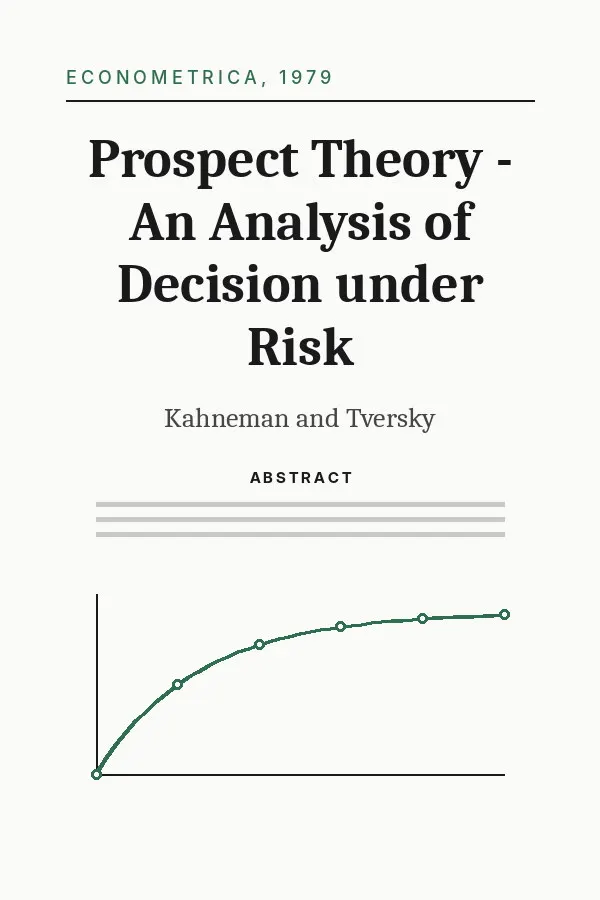
People do not value outcomes as final states of wealth. They value changes from a reference point, and they treat the two directions differently: a loss weighs more than a gain of the same size, each further unit matters less than the last in both directions, and so people are cautious when choosing among gains and willing to gamble to avoid a sure loss. Probabilities are bent as well: certainty is prized out of proportion, and very small chances are given too much weight.
How I used it in the workshop. The three exercises for 🤝 Brightwater Studio - pricing workshop came straight from it:
- The same discount described once as a saving and once as an avoided surcharge.
- Where the customer's reference point sits: the list price, or last year's invoice.
- Why taking a feature out of a plan hurts more than never offering it.
Slide 9 was corrected before the recording went out: the two-to-one figure is from their later work, not from this paper. Still to do: add the original problems as an appendix for the next client.
⚡QUICK JOTS
- Read for 🤝 Brightwater Studio - pricing workshop, in the wrong order. On Friday 11 April I taught ten people about losses and reference points from the textbook version. On Saturday I read the original, to find out whether what I had said was true.
- Mostly, yes. I had overclaimed in one place, and it is in the analysis below.
- Twenty-nine pages. The first half is a series of small bets that knock the standard theory over one leg at a time. The second half builds the replacement. I followed the first half completely and the second with a pencil.
- Close to the course as well. The weeks on expected value in 00. Statistics for Product Decisions I Hub assume a chooser who, according to this paper, does not exist. I read the algebra anyway and regretted about four pages.
- Read the same day I wrote the reflection about enough, with Housel just finished. A paper about how people weigh losses, on a day about a savings target. Not planned.
🖍️ANNOTATIONS
The first set of problems
The value curve
The editing phase